
The great thing about getting older is you don’t lose all the other ages you’ve been. Madeleine L’Engle
Birthdays are an annual reckoning, aren’t they? Of all the days in the year, it is the one marked for each of us. And the time between first breath on that date and last—whenever that may be—defines the parameters of our time on earth.
I love my birthday. It insists, each year, on a time of both reflection and thanksgiving. Some thoughts this year:
- There should be some general, overall improvement in us and our temperament as time goes by. This is certainly true for the Christian believer if we are paying attention to the Word. It isn’t a matter of just being nicer or kinder or more thoughtful. It has to do, I think, with the surer knowledge that our time on this mortal coil, to use a rather odd, anachronistic phrase, is preparation for a significantly longer stretch of time called eternity.
- I do find myself thinking a lot more about what lies beyond that final breath. It isn’t morbid curiosity, may I say—just curiosity.
- These thoughts are often prompted by beauty. My husband and I drove out to the coast on my birthday as the sun was beginning to break through a persistent marine layer. Between where we live in Santa Rosa (CA) and the Pacific is the lower end of the Coastal Range that runs along the western edge of Northern California. The rolling hills are already turning green in places with recent autumn rains. We passed Redwood groves, apple orchards, dairy farms, and vineyards in a breathtaking panorama. Fields of gold and russet and the new green began to glow as shafts of afternoon sun found them. It was a stunningly beautiful drive. When we have these moments of wonder, how can we not think of what lies beyond, what is being prepared for the believer, what has been promised by Christ himself?
- What, I ask myself, am I not doing that should not be left undone? This may have to do with relationships. Seriously, is there anything between me and another person—whether family or not—that needs mending? The regret of a relationship broken or strained, but (and you know when this is possible) mendable, then severed by death, can be a lifelong torment. We should ask ourselves that question that came up so often in the 80s: What would Jesus do? Figure it out. Then do that.
- What about other things? For me, it’s photos. Thousands of them. Not just my own, but large quantities left by family members who passed away without sorting them, tossing large quantities, then putting what’s left in albums. I intend to have mercy on my own kids and do something about the lot. As of today, that project remains undone. It shouldn’t. By my next birthday, I expect to have heeded my own counsel and taken care of business.
I want to say the following with great care and emphasis: Regardless of the state of affairs in the world, regardless of the steady diet of chaos fed the public by social media and the news business at large, regardless of the difficulties that may be presenting in our own lives at any given time, we need to cultivate a heart of love and an attitude of thankfulness.
Regarding the need for love among believers, Peter writes:
Love one another fervently from a pure heart (1:22).
Fervently, in this context, means intensely. Interestingly, the only other time this adverb appears in scripture is when the church was praying for Peter himself to be released from prison in the Book of Acts. A bit later, Peter adds:
Above all things have fervent [intense] love for one another, for love will cover a multitude of sins [for only then can you forgive as you are instructed to forgive, as you hope to be forgiven].
If I am to love as Jesus (my Savior) loves, then any whiff of unlove in my heart must be extinguished.
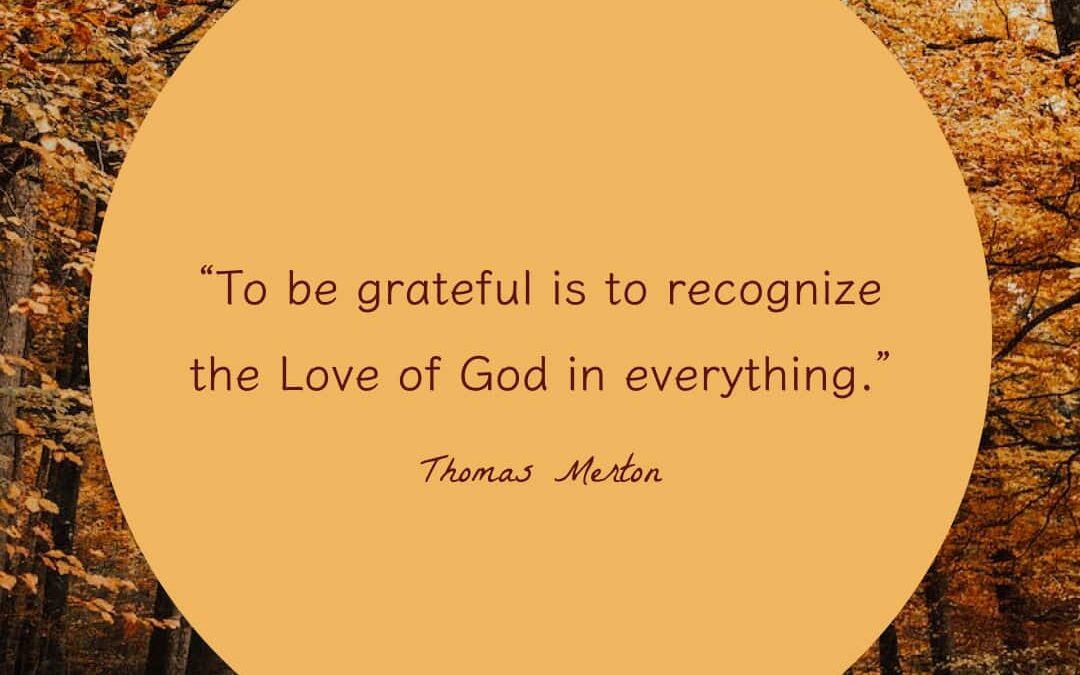
Regarding thankfulness, I think it is a by-product of a loving heart. It is one of the things that flourishes within the scope of love’s power and enabling influence. In Colossians 3:15, Paul gives this short instruction at the end of the verse:
Be [implying striving after an aim as not yet realized] thankful.
C. S. Lewis wrote:
We ought to give thanks for all fortune: if it is ‘good,’ because it is good, if ‘bad’ because it works in us patience, humility, and the contempt of this world and the hope of our eternal country.
There it is. That drawing of the glance to the “eternal country.” Cultivating a heart of love and an attitude of thankfulness not only blesses all those within our sphere but also prepares us for eternity.
All three of our children and their families live near us, a fact I will never take for granted. Our oldest son pastors our church, and we are all, including our two teenage grandchildren, working in various ministries. For every birthday, we have dinner together. This evening, we gathered around the table, beautifully decorated for autumn, at our daughter and son-in-law’s home. The meal was delicious. We laughed a lot. I opened my presents, including handmade ones from some of the grandkids, and sweet handmade cards. I was aware throughout the evening of the spirit of love permeating our time together. It was no accident, not something foreign to what we usually experience as a family. It is, however, a result of intentional patience, forbearance, and forgiveness within our relationships. And over them all, love and thankfulness.
I mention this because, in my New Year, I intend to increase the presence of both in my life, adding beauty to all the ages I’ve already been. I hope you are encouraged, birthday by birthday, to do the same.